Proposals That Did Not Pass
Proposals that were voted on but did not pass
- 12/8/204: Who is a Spoke?
- Worm Bin
- 12/04/2025: How to make a proposal
- 12/2/2025: Who is a Spoke
- Spokes proposal - meeting schedule
- RC Coordination Chat
12/8/204: Who is a Spoke?
Who is a Spoke?, Frankie, created: 12/8/24
-
A Spoke is:
- a group of >5 people AND
- the group has access to Woodbine’s physical space (i.e. can unlock the door) or Woodbine’s resources (e.g. website, Instagram, lease, funds)
-
What if your group is <5 people?
- Identify a larger working group that you can caucus with. Perhaps the group that grants you access to the Woodbine space/resources
- Still come to the Spokescouncil meeting to observe and recruit members
-
What if our group doesn’t have the door code or its own access to Woodbine resources?
- Your spoke is the one that grants you access to the space.
- For example, if Gym people unlock the space for you, you caucus with Gym
- Your spoke is the one that grants you access to the space.
-
The proposal contains no opinion on how Spokes decide on a Spokesperson
comments (format: commenter name: comment)
- Ash: I like this idea of caucusing if your group is <5 people. We can talk to co-workers about this and if they want, they could caucus with yoga or another analogous wg with similar needs.
- Ash: we may need to have some suggestions on how to consider which group you will be part of during a fishbowl spokescouncil. you may be a spoke of one and the observer of another group. can you be a spoke for multiple groups at one meeting? my gut is no. this could be a structure we offer and could be good to push and allow more ppl to be spokes.
- Briar: this seems like a really elegent solution. by having straight-forward criteria about “who is a spoke,” we don’t need to have a process for adding new spokes. something to consider, though: who decides who has the keycode? could that person or group of people exercise undue influence over the composition of the spokescouncil?
Worm Bin
Proposal Title
Person or group submitting
- Name
Proposal History
- Submission Date:
- Vote date:
- Vote result:
Motivation (why are you proposing this?)
- list motivations for proposal
Proposal summary
- one sentence to describe the proposal (at the end of this document, you will include a detailed description)
Details
Background info
Any background info needed to understand function of proposal
Group(s) this proposal will affect
List of groups or people this affects
Labor required
Labor that will be needed, initial and ongoing. List the tasks that will be involved
Individual or group doing labor
Who will do the work required to enact this?
Money required
Does it cost anything? Will it cost anything in the future?
Proposal Description (and variations)
Write a detailed proposal description. If there are variations for people to choose between, list those as well
A) Cute name for a specific proposal
Text of specific proposal
B) Cute name for a specific proposal
Text of specific proposal
C) Cute name for a specific proposal
Text of specific proposal
12/04/2025: How to make a proposal
“How to make a proposal”, Violet, 12/4/25
Found some good language on how to make a proposal. Am proposing this as an answer to how to make a proposal, which can come from anyone:
Present Proposal or Issue
When possible and appropriate, proposals ought to be prepared in writing and distributed well in advance of the meeting in which a decision is required. This encourages prior discussion and consideration, helps the presenter anticipate concerns, minimizes surprises, and involves everyone in creating the proposal. (If the necessary groundwork has not been done, the wisest choice might be to send the proposal to committee. Proposal writing is difficult to accomplish in a large group. The committee would develop the proposal for consideration at a later time.) The presenter reads the written proposal aloud, provides background information, and states clearly its benefits and reasons for adoption, including addressing any existing concerns. (basically the food co-op method LP shared
Currently I’m thinking the express purpose/method of the spokescouncil should be to create cohesion between all of the working groups within the space and to be a means of facilitating decision-making being made by the “at-large membership” of Woodbine.
I found this to be a compelling argument against consensus, addresses a lot of concerns people have of small influences blocking functioning of the council. https://theanarchistlibrary.org/library/andrew-flood-a-practical-guide-to-anarchist-organisation#toc61
Two quotes from above in the text that support this argument “In working out a libertarian concept of organization, we need to remember that the individual members not only have rights that must be respected by the organization, they also have obligations to the rest of the membership. Since the majority have the right to control their own organization, individuals must conduct themselves so as to respect this right of the majority.”
“The idea is that the main decision-making responsibility of the organization is not to be delegated to some “steering committee” or executive but is conducted directly by the membership through their own discussions and votes; this is the heart of the libertarian concept of organization.”
I think a sort of synthesis of consensus and voting could work well. Consensus works well for small groups with a cohesive purpose; the working groups of woodbine have many purposes but possibility of common ideals. if we take the elements of proposal making and reworking from the consensus process, i.e. giving everyone an opportunity to have input but removing blocking power and even the potential for a small united minority to sabotage decision-making. after an established time period the spokescouncil will take proposal with suggestions and rework into a new coherent proposal to be voted on by everyone. votes can be tallied in a transparent manner through thumbs up/thumbs down reacts in group chats and then added to a google sheet accessible by all but only editable by spokescouncil. in the case of urgent issues the spokescouncil should be empowered to decide within group chat or emergency meeting with availability for feedback from wider membership later.
So for example:
Non-urgent: there is a proposal that any group that eats food during their meeting must clean the area when their meeting is finished. if you sit on couches then vacuum couches and rug. if you sit at tables then wipe down tables and sweep underneath them. make sure all food waste and other waste go into proper receptacles. if it is a trash night please help take out trash. > two weeks have gone by and suggestions are made > spokescouncil disseminates to their working groups > groups vote > votes are tallied and proposal is implemented if passed or retooled and re-presented if failed
Urgent: refrigerator stops working and an obvious fix can’t be determined by folks on site> spokescouncil votes to call electrician > after the fact there is feedback that skilled individuals in working groups could have fixed instead > proposal is made to form a repairs working group that can be tapped in case of future technical issues to save money
people would have to declare what group they vote in or something like that to not have redundant/extra votes. it might be more efficient to put decision making power more firmly in the hands of the council with the possibility for feedback from wb at large. proposal posting ahead of spokes meetings would ensure transparency and allow time for feedback. it depends on how much we want to empower individuals and how much we think the people who show up to woodbine want to run it. concentric circle structure can mitigate some of that, for example the strength collective votes on space proposals rather than the whole strength community, but that isn’t moving toward the broadest sense of autonomy and community involvement imo
comments (format: commenter name: comment)
-
Ash: I agree with non-consenus model. From the linked text “The structural requirement of unanimity puts pressure on the majority to placate small minorities in order to accomplish something. Often this leads to decisions that paper over disagreements and leave everyone dissatisfied.” This is super important to remember imo. Even in smaller group interactions in the space, we are ideally striking a balance b/w supporting minority voices that are valid (especially when we are attempting to correct structural bias like racism and misoginy) but also to make sure we are not being hamstrung by a small group or even one person’s voice overriding the group moving forward. anarchists are often way too nice (because we want to see everyone as acting in good faith and want to be sensitive to our own biases)! sometimes people are assholes and bad faith actors and no one has a right to take over a discussion and it’s ok for people to call that out. Something to consider as a group is we can ask ourselves if
- if the minority voice is bringing up something the rest didn’t consider but most people see as needing to be adressed
- the minority voice is representing bad faith intentions to stall or distract people from moving forward
- it’s a good faith disagreement that most of the group doesn’t concur with.
The response to
- is to reconsider the issue and draft a new proposal.
- there should be some way to publicly call this bad faith or distraction out and move forward. if
- ackowledge and reiterate the shared value of non-consensus and why we have that value and move forward with respect for that person’s dissent. Conflict support skills might become very important in the case of 2. and 3. and we should be ready to offer that pro-actively.
-
Ash: I am a little confused about how the mixture of consensus and voting ideas would happen in reality and how the signal chat would be involved. This feels like we need to dig into this irl in the meeting and talk through how this would work and weigh it against other methods including the “Proposal is passed if consensus minus 2”. is this the very basic method we use to pass a proposal to start? I wonder if we can develop more complex systems as we go along and face the problems this will bring up v. overwhelming ppl with a complex process
12/2/2025: Who is a Spoke
“Who is a Spoke”, Briar, 12/2/25
This is based on what I heard people saying during our last meeting. If you have amendments you’d like to make, please feel free to do so in the chat prior to the meeting.
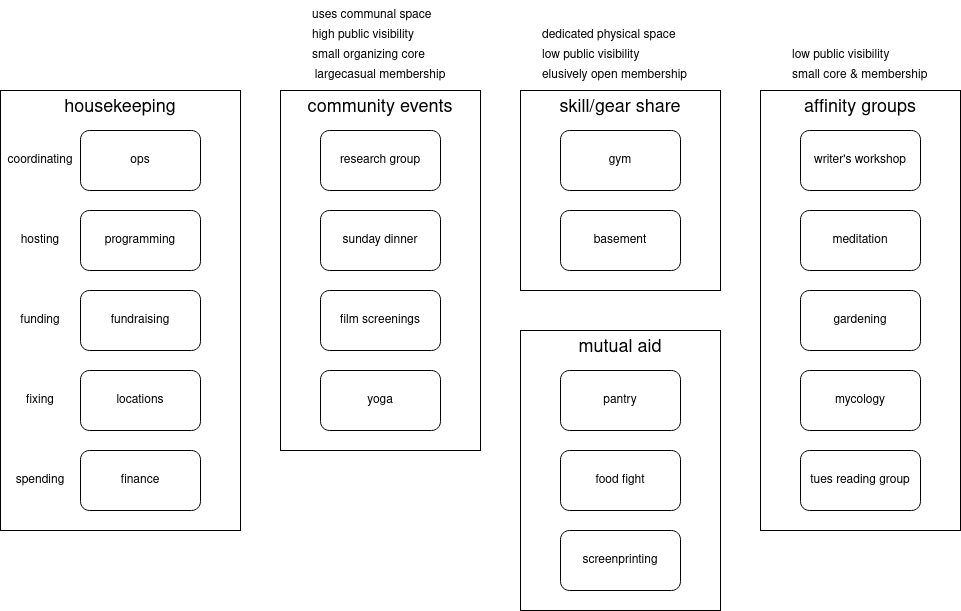
I propose that all current working groups at Woodbine become spokes. If new working groups are formed, they can become spokes with the approval of the spokes council. The current working groups include: operations, location, programming, finance, gym, mycology, basement, pantry, research group, yoga, film screening, meditation, dinner, gardening, fundraising, writers workshop, food fight, Tuesday night reading group, and screen printing.
We may want to add something about how each spoke representative must be voted into that position by their respective group
We may also want to consider the amount of influence that any given individual could exercise with the proposed spokes. We need consensus minus 2 to pass proposals. Is there any concern that with the listed working groups, a highly involved individual might be able to influence 3 or more spokes
comments (format: commenter name: comment)
- Ash: i suggest coworking isn’t a working group in the spokescouncil until there are more co-workers
- Violet: each spokesperson could be asked to commit to 3-6 months of representing their wg in the spokescouncil
- Ash: about choosing who is a “spoke” - We state that we value autonomous operation and each working group is functionally very different. Autonomy imo will help ppl feel more excited and accountable if we can also offer clear suggestions to try so ppl aren’t overwhelmed with the ask.For example a working group doesn’t necessarily need to do elections to choose a spokesperson if ppl step up and rotate willingly based on everyone sharing a sense of what is needed
- Ella:Agreed re: autonomy. For a suggested model, one super simple way for groups to choose spokes might be for someone to send out a text “Emoji react if you’d volunteer to be a spokes this term” and then I bet we could find some tool where one of those people who reacted to the text is randomly selected (if needed). Seems elections could become kind of toxic popularity contests, promote competition within groups etc imo
- Violet: super simple tool out there on the interwebs (just searched randomized selector) https://pickerwheel.com/
- paul: here’s a little map I made grouping the WGs by how I intuit they relate to the space

Spokes proposal - meeting schedule
Spokes proposal - meeting schedule - LP
Motivation
- I find the survey -> meet -> survey loop to be cumbersome and noisy.
- I think regularity can be good for keeping a tempo
- As we don’t have a shifting role identified as convener, it vests responsibility in individuals vs the body.
Proposal: Change spokes meeting schedule to one of the following processes, or don’t, and stay with what we have.
Details
Plenum vs klatch
Plenum: An assembly or meeting with all members present.
Could just call a general meeting, all-hands meeting, full meeting.
Klatch: An informal group that gathers more or less frequently, especially for conversation.
Could just call a get together, meetup…
Groups this affects
Everyone
Work required
General survey, or compiling data from previous surveys
Noting selected day/times in a doc somewhere
Money required
None
Proposals
A, B, C, or none.
A) 1-2-GM bounce
Identify two broadly available time/days in a general survey.
Alternate meetings between those day/times.
Do full surveys for GMs.
A) 1-2-3-GM bounce
Identify three broadly available time/days in a general survey.
Alternate meetings between those day/times.
Do full surveys for GMs.
B) Alternate GMs between survey day/times on a set timing
https://basement.woodbine.nyc/spokes-proposal-template#
RC Coordination Chat
Proposal Title
Person or group submitting
- Ash
Proposal History
- Submission Date: 8/27/25
- Vote date:
- Vote result:
Motivation (why are you proposing this?)
- We need a signal chat that can bring together members of working groups who have signed an MOU (for legal liability) to discuss urgent matters than may affect most WGs.
Proposal summary
- The RC Coordination Chat (RCCC) is a signal chat that is open to members of working groups who have signed an MOU. This chat will be a space for communicating key code changes, liability issues, important space announcements, discuss urgent matters than may affect most WGs, ask for help with projects, and raise urgent concerns about what is happening in the space.
- We will need to define expectations for the RCCC regarding decorum, accountability and participation to ensure good faith communication and timely responses to urgent matters. Including how when members can be removed from the chat (lapses in meeting expectations consistently or when someone knows they can no longer participate and will opt out).
Details
Background info
Any background info needed to understand function of proposal
Group(s) this proposal will affect
All members of WGs who sign MOUs, admins of the RCCC (I recommend all members of WGs who sign MOUs should automatically become admins)
Labor required
-Liability holders who write the MOU will need to add signers to the chat and make them admins
-Admins will need to be responsive to announcements in a timely manner, notify the chat when they may be leaving town for extended periods or need to leave the chat due to inability to participate.
Individual or group doing labor
-Liability holders
-Chat admins
Money required
none